Is facial biometrics Dead ? Why This Technology Is Failing in Fraud Prevention and User Experience
When a technology becomes a commodity and remains widely used for a long period, it inevitably becomes vulnerable to fraudsters who learn how to circumvent it. Cybersecurity professionals are reporting a rasing thend o frauds that circunvent facial biometrics. The widespread availability of personal photos on social media, combined with the rise of AI-powered fraud such as deepfakes, is increasingly challenging the effectiveness of facial biometrics.
Has Facial Biometrics Reached Its Limits?
Facial biometrics has not disappeared, but it is no longer the standalone solution the market once promised. It remains a valuable technology for identity verification and authentication, and millions of people use it every day to unlock smartphones, access banking services, and open digital accounts. However, the threat landscape has changed dramatically over the last few years. The rise of deepfakes, biometric data breaches, and increasingly sophisticated identity fraud schemes has exposed the limitations of relying exclusively on facial recognition. What has truly ended is the era of blind trust in facial biometrics as a single layer of security. Today, organizations must view facial recognition as one component of a broader identity strategy that combines multiple authentication factors, device intelligence, liveness detection, and continuous risk assessment to effectively protect both users and businesses.
Is Facial Biometrics Secure Against Fraud?
Facial biometrics is secure only when combined with multiple layers of protection. On its own, it faces a fundamental challenge: a person’s face is public and frequently shared across social media platforms, professional networks, and online communities. High-quality photos and videos can often be collected from publicly available sources, providing valuable material for fraudsters to develop increasingly sophisticated attacks. Advances in artificial intelligence, particularly deepfake technology, have made it possible to create realistic facial simulations that can deceive poorly protected biometric systems. For this reason, the effectiveness of facial recognition depends not only on matching algorithms but also on complementary controls such as liveness detection, device integrity checks, behavioral analysis, and strong identity verification processes.
How Do Deepfakes and Facial Biometric Cloning Bypass Security Systems?
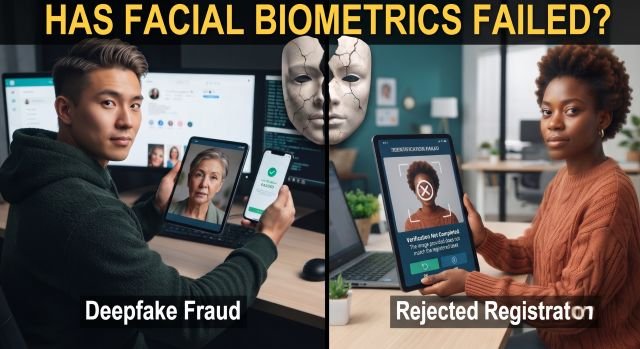
Deepfakes succeed when criminals generate synthetic videos of a victim’s face and inject them into the authentication process instead of using a real camera feed. Fraudsters use personal pictures (usually collected from documents or social networks), to generate fake indentities of fake videos capable of bypassing facial biometric systems.
What Are the Main Weaknesses of Facial Biometrics and How Do Criminals Exploit Them?
The primary weaknesses of facial biometrics include inadequate liveness detection, acceptance of injected or manipulated images, insufficient identity verification during the enrollment process, and weak account recovery procedures. Fraudsters exploit these vulnerabilities by using deepfakes, virtual cameras, and stolen identity information to impersonate legitimate users. Many systems still rely on predictable liveness challenges that modern AI tools can easily replicate. In some cases, criminals bypass security not by defeating the recognition algorithm itself, but by compromising the processes surrounding it. As a result, even advanced facial recognition systems can become vulnerable when they are not supported by strong, multi-layered security controls.
Can a Facial Data Breach Cause Permanent Damage?
A facial data breach can create permanent consequences because, unlike passwords, people cannot change their faces. Once facial images or biometric templates are exposed, they may be reused by criminals for years in identity theft and impersonation schemes. This makes facial biometrics a particularly sensitive type of personal data that requires enhanced protection. To reduce this risk and improve resilience, companies should avoid relying on a single biometric factor. Offering alternative biometric options, such as fingerprint verification, provides users with greater flexibility and creates an additional layer of security if facial data is ever compromised.
Why Do Users Say, “I Can’t Register My Face”?
Higher rejection rates often stem from imbalances in the datasets used to train facial recognition algorithms. When certain demographic groups are underrepresented during the development process, the resulting models may perform less accurately for those populations. Technical factors can also contribute to the problem. Variations in skin contrast can affect image quality and the amount of facial detail captured by cameras, particularly under challenging lighting conditions. In addition, facial characteristics such as eye shape, facial contours, and other anatomical features may be interpreted differently by algorithms that were not adequately optimized for diverse populations. Historical biases in both training data and system design can further amplify these disparities, leading to unequal performance across racial and ethnic groups. The result is a frustrating user experience, lower accessibility, and increased legal and reputational risks for organizations that rely on facial recognition as a primary method of identity verification.
Why Do Older Adults Struggle with Facial Biometrics?
Older adults often face difficulties because facial biometric systems combine unfamiliar technology with physical and cognitive demands. In addition, changes in face (such as hair loss, wrinkles and signs of aging on the face) and use of glasses can impact facial biometrics.
Why Do People of African and Asian Descent Experience Higher Rejection Rates?
Higher rejection rates often stem from imbalances in the datasets used to train facial recognition algorithms. When certain demographic groups are underrepresented during the development process, the resulting models may perform less accurately for those populations. Technical factors can also contribute to the problem. Variations in skin contrast can affect image quality and the amount of facial detail captured by cameras, particularly under challenging lighting conditions. In addition, facial characteristics such as eye shape, facial contours, and other anatomical features may be interpreted differently by algorithms that were not adequately optimized for diverse populations. Historical biases in both training data and system design can further amplify these disparities, leading to unequal performance across racial and ethnic groups. The result is a frustrating user experience, lower accessibility, and increased legal and reputational risks for organizations that rely on facial recognition as a primary method of identity verification.
Do Cosmetic Procedures Affect Facial Recognition?
Cosmetic procedures can affect facial recognition when they alter the landmarks and proportions that algorithms use to compare faces. Facial recognition systems rely on the relative position of key features such as the eyes, nose, cheekbones, jawline, and mouth to establish a biometric match. Procedures including rhinoplasty, eyelid surgery, chin augmentation, dermal fillers, botulinum toxin injections, and facial contouring can significantly modify these characteristics, sometimes reducing the accuracy of the comparison. Even less invasive changes, such as substantial weight loss, facial hair growth, heavy makeup, or changes in hairstyle, may interfere with the system’s ability to recognize a previously enrolled user.
As facial appearance evolves over time, the gap between the enrollment image and the individual’s current appearance can increase, resulting in false rejections and a poorer user experience. In many cases, organizations must request a new biometric enrollment, creating additional friction for legitimate users while introducing potential security risks during the update process.
What Is the Best Path Forward?
Organizations should treat facial biometrics as one layer of security rather than the only line of defense. One option could be combine facial with other biometric options, such as fingerprint, iris, voice and behavioral biometrics.
Learn about HA Tecno fingerprint-based biometrics for smartphones and heartbeat-based liveness test (contact us by WhatsApp).
So, Has Facial Biometrics Reached Its Limits?
Facial biometrics has not disappeared, but the era of relying on facial recognition alone is over.
Read another article about the theme: What are Deepfakes and how they affect your biometrics ?