Blog
Mobile Biometrics: Facial and Fingerprints

Biometrics in smartphones and mobile devices has become a key technology in today’s authentication architectures. It has been driven by the COVID‑19 pandemic and by technological advances in sensors, embedded processing, new algorithms, and AI. In a world where smartphones act as gateways to financial, governmental, corporate, and personal services, the reliability of biometric authentication has become almost mandatory.
Biometric Technologies
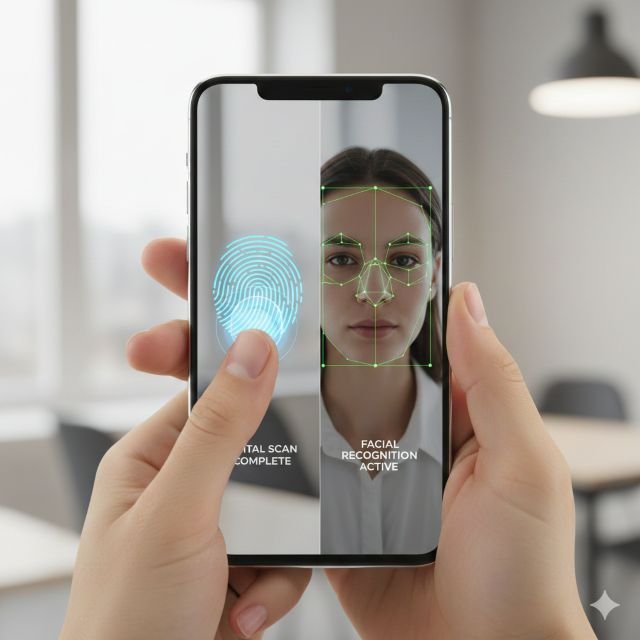
Among the most widespread technologies in the market is the fingerprint sensor. In smartphones, this technology is generally ultrasonic, with sensors integrated under the screen that emit acoustic pulses capable of penetrating the layers of the skin and returning a biometric image. Unfortunately, this type of sensor has been discontinued by manufacturers such as Apple.
Fortunately, a new technology is emerging: fingerprint capture using the smartphone camera. This approach enables consultation of public databases for more secure onboarding and is considered a “contactless” biometric technology.
Facial recognition is another widely adopted technology that continues to expand in the market. Early 2D systems relied solely on the front-facing camera, but some manufacturers now incorporate infrared projection and 3D mapping. Authentication is performed through biometric metrics that evaluate the similarity between the captured image and the previously stored template.
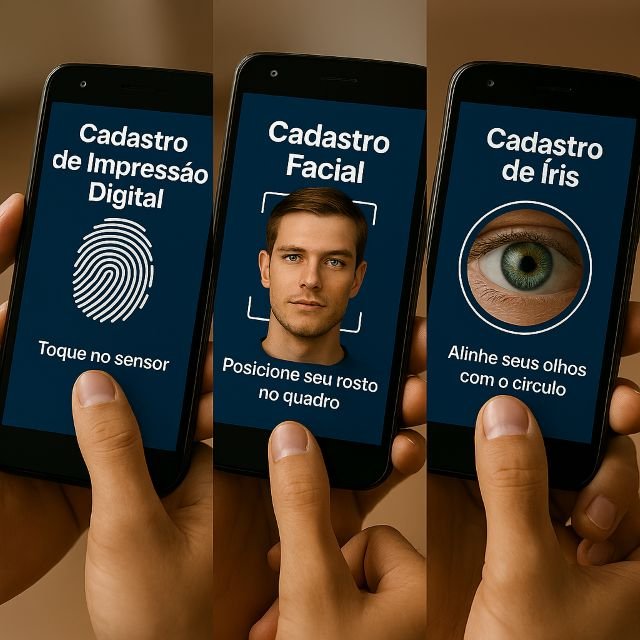
Other mobile biometric modalities include iris recognition, voice analysis, and behavioral biometrics.
Facial Recognition being challenged by AI Frauds
AI‑driven fraud attacks are creating new pressure on facial recognition systems by exploiting the very data people share online. With the rise of deepfake tools and generative models, criminals can now produce highly realistic synthetic faces, voice clips, and even full-motion videos using nothing more than publicly available photos from social networks.
These manipulated images are then used to fool identity verification systems, bypass onboarding checks, or impersonate legitimate users. The sophistication of these attacks has grown so quickly that traditional 2D facial recognition, once considered secure, is now vulnerable to spoofing attempts that look convincingly real to both humans and machines.
As generative AI continues to evolve, facial recognition must evolve with it, adopting continuous authentication and adaptive risk analysis to stay ahead of increasingly sophisticated attacks.
Data Protection
Protecting biometric data is a critical concern. In current solutions, the processing and storage of biometric templates occur in isolated and secure environments. These environments run verified software, use encryption, and isolate access to sensitive data. Additionally, biometric templates (the features extracted from biometric images) are not images themselves but numerical representations that are nearly impossible to associate with a person on their own, making reconstruction of the original image impossible.
Communication between sensors/readers and biometric processing systems is encrypted, ensuring the integrity and authenticity of the images. Liveness detection techniques are essential to mitigate attacks based on fake photos, videos, prosthetics, or masks.
Challenges
A major challenge today is combating AI‑driven fraud that uses photos from social media. A growing trend to mitigate this problem is the use of multibiometric systems and continuous authentication, in which multiple biometric and behavioral signals are combined to increase robustness without adding friction.
In short, mobile biometrics is here to stay and continues to evolve alongside technological changes and the shifting fraud landscape.
Want to learn more about our mobile fingerprint biometric technology? Visit our website