BLOG
New Trends in Behavioral Biometrics

New Trends in Behavioral Biometrics
Behavioral biometrics has become one of the most frequently searched and discussed topics in digital security. Although it generally offers higher accuracy and is sensitive to environmental and human behavioral variables, its use has been gaining increasing importance. But what exactly is new in this field, and why is it becoming so central to digital identity?
How Behavioral Biometrics Is Redefining Digital Identity
In recent years, the evolution of digital identity in Brazil has been driven by a combination of biometric and behavioral technologies. The widespread adoption of mobile biometric enrollment, the rise of contactless authentication processes—such as facial recognition and fingerprint capture through smartphone cameras—and the integration of these tools into banks, companies, and public services have made digital authentication part of everyday life.
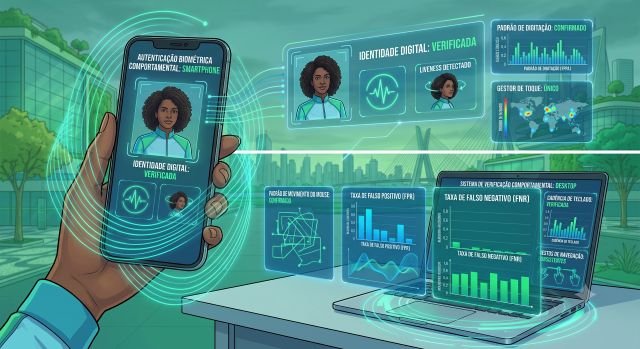
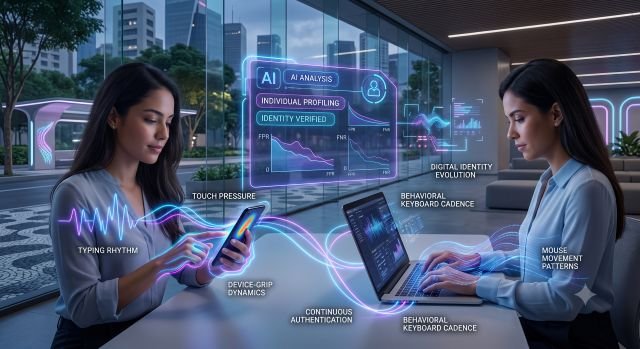
However, as these solutions advance, awareness has grown that facial recognition does not perform perfectly in all contexts. This is precisely where behavioral biometrics becomes relevant. Unlike traditional methods that rely on physical traits such as facial features or fingerprints, behavioral biometrics analyzes patterns of human behavior: typing rhythm, navigation speed, how a person holds their phone, mouse movements, and other subtle interactions. These patterns are unique, extremely difficult to forge, and highly effective as complementary security layers.
What Is Biometric Enrollment and Why Does It Face False Positives and False Negatives?
Biometric enrollment—whether facial, fingerprint, or iris—is the process of collecting physical characteristics for authentication. It is widely used in banking, government services, and customer onboarding platforms. Despite its popularity, it faces important limitations.
A common issue is the false positive, when the system mistakenly identifies one person as another. This can occur in environments with poor lighting, low‑quality cameras, or in populations with high phenotypic diversity. Conversely, false negatives happen when the system fails to recognize a legitimate user, causing frustration and unnecessary blocks.
These challenges are especially critical in processes such as proof of life and liveness detection, which must ensure that the user is physically present and truly who they claim to be. Behavioral biometrics acts as an additional layer that reduces these errors by analyzing patterns that do not depend solely on captured images.
Why Facial Recognition Does Not Work Perfectly in Real‑World Environments
Although facial recognition has advanced significantly, it still faces obstacles when applied at scale. Real‑world conditions—lighting, aging, accessories, camera quality, or even changes in hairstyle—can compromise accuracy. In regions with intense sunlight, facial capture may be hindered. In cities like Curitiba, São Paulo, or Recife, where weather conditions vary widely, algorithm performance can fluctuate.
These challenges reinforce the need for complementary technologies such as behavioral biometrics, which do not rely on external conditions to function effectively.
How Behavioral Biometrics Improves Customer Transaction Security
Customer transactions—whether in financial services or e‑commerce—are among the most common processes for banks, insurers, and digital platforms. These processes must be fast, secure, and frictionless. When facial recognition fails and users abandon the process, companies lose business opportunities and revenue.
Behavioral biometrics enters as a silent, continuous solution. During onboarding or authentication, it analyzes factors such as:
- typing speed
- pressure applied on the screen
- how the phone is held
- navigation patterns
- involuntary micro‑gestures
These elements help confirm user identity even when facial systems show inconsistencies. They also enhance fraud detection, reducing dependence on images alone.
Market Trends Shaping the Future of Behavioral Biometrics
1. Focus on Continuous and Adaptive Authentication
Security paradigms are shifting away from one‑time authentication (only at login) toward continuous authentication.
What’s new: Recent studies highlight systems that passively monitor user behavior throughout the entire session. If typing patterns or mouse usage suddenly change—suggesting session hijacking or bot activity—the system can block access or require instant physiological verification.
2. Multimodal Fusion Models
Research in 2025 emphasizes models that integrate heterogeneous biometric signals into unified trust‑assessment frameworks.
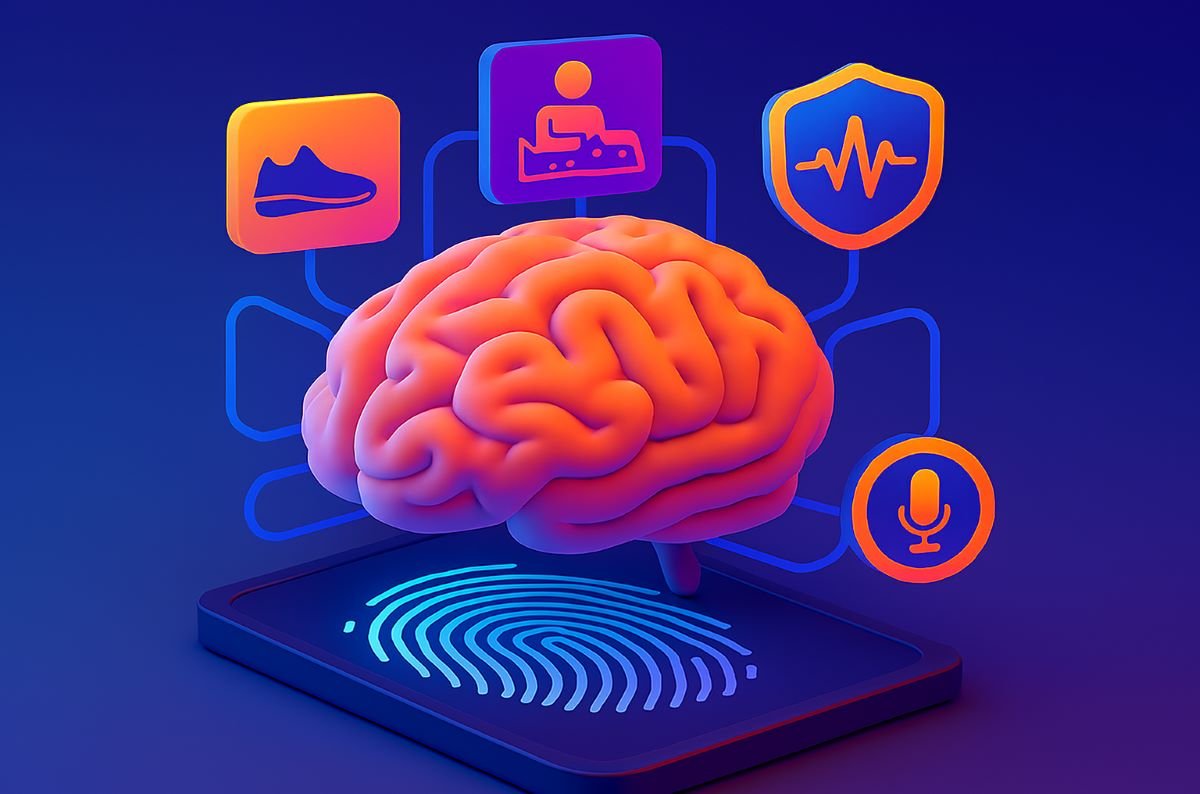
What’s new: Instead of relying solely on typing dynamics, new algorithms combine multiple vectors: gait analysis, touch dynamics, and device‑grip gestures. This multimodal fusion dramatically increases accuracy and makes systems nearly impossible for attackers to replicate.
3. Advanced AI and Deep Learning
What’s new: Deep Learning enables systems to capture and analyze more than 2,000 parameters from a mobile device, including finger pressure, phone tilt angle, and scrolling rhythm.
Adaptability: AI algorithms are becoming better at learning user individuality. They create highly personalized models that evolve as user behavior changes over time—due to fatigue, urgency, or other factors—reducing false negatives.
4. Privacy‑Preserving Behavioral Biometrics
Strict regulations such as Brazil’s LGPD and Europe’s GDPR have driven research toward ethical and secure data collection.
What’s new: Studies explore integrating behavioral biometrics with privacy‑preserving techniques such as:
- Federated Learning: Models are trained directly on the user’s device, sending only mathematical updates—not raw data—to central servers.
- Homomorphic Encryption: Allows computations on encrypted data without ever decrypting it.
5. Combating Synthetic Fraud and Bots
Behavioral biometrics is proving essential for distinguishing humans from AI systems and bots.
What’s new: Research focuses on “proof of personhood.” While AI can replicate voices and faces through deepfakes, reproducing the unpredictability and micro‑variability of human movement—typing or mouse behavior—is extremely difficult.
Applications: Heavy use in financial services to prevent synthetic identities in online credit applications and detect fraud bots operating within authenticated sessions.
How Behavioral Biometrics Strengthens Proof of Life and Liveness
Proof of life is critical for retirees and pension beneficiaries. When facial recognition fails, users must travel to physical branches, causing inconvenience and cost.
Behavioral biometrics validates identity even when facial capture is imperfect. It analyzes:
- movement patterns
- how the device is held
- involuntary micro‑gestures
- interaction rhythm
This allows systems to confirm that the user is alive and present, reducing the need for travel and making the process more inclusive.
Why Behavioral Biometrics Is Essential for the Future of Digital Security
Digital security is undergoing a profound transformation. As more services migrate online, the need for authentication methods that are both secure and accessible grows.
Behavioral biometrics meets this demand because it is:
- hard to forge, relying on unique behavioral patterns
- silent, requiring no explicit user action
- adaptive, learning from user behavior over time
- inclusive, functioning even when facial recognition fails
Combined with other technologies, it creates a more robust security ecosystem capable of serving banks, governments, companies, and citizens.
Conclusion: The Role of Behavioral Biometrics in the Coming Decades
Behavioral biometrics is not just a trend—it is a natural evolution of digital identity. It emerges as a response to the challenges faced by facial recognition, traditional biometric enrollment, and proof‑of‑life processes.
As Brazil moves toward an increasingly digital future, this technology will become a fundamental part of security infrastructure. Whether in customer onboarding, contactless authentication, or fraud prevention, behavioral biometrics is ready to take a central role. The future of digital security will be hybrid, continuous, and behavioral.