BLOG
Biometric Systems: What Do I Really Need?

Biometric Systems: What Do I Really Need?
Many people ask, “What exactly is a mobile biometric system?” Let’s clarify this in more detail.
Below is the fully translated version of your article, including fingerprint biometrics, palm print biometrics, SEO‑friendly structure, and references to FIDO2.
What truly makes up a modern biometric system for mobile applications?
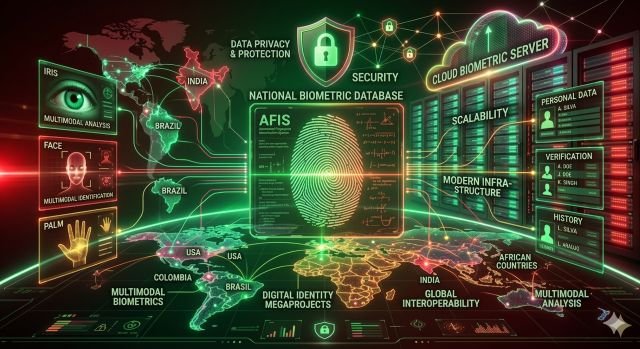
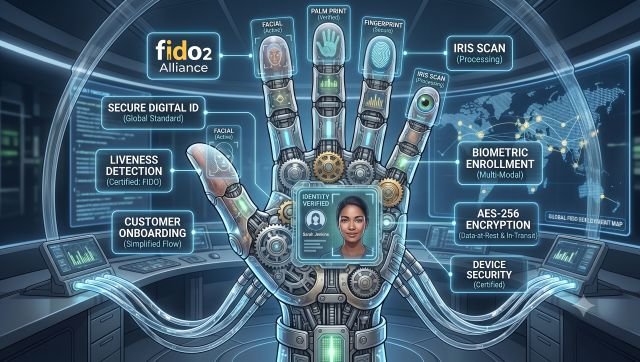
Biometrics have evolved far beyond the selfie. Today, digital identity systems combine multiple modalities — facial recognition, fingerprints, palm print, liveness detection, cryptography, and standards like FIDO2 — to ensure security, accuracy, and a smooth mobile experience.
With the growth of liveness checks, contactless customer onboarding, facial biometric enrollment, and the increasing need to reduce fraud, it has become clear that facial recognition alone often does not work reliably. This happens because a biometric system is a complex chain, and each stage must be robust.
This article explains, clearly and objectively, what constitutes a complete biometric system, which requirements it must meet (according to Anil Jain), how to measure its performance, and what cybersecurity teams should evaluate before selecting a solution.
What is biometric enrollment and why is it so important today?
Biometric enrollment is the process of collecting and storing an individual’s unique characteristics. In modern systems, this includes:
- Facial biometrics
- Fingerprints
- Palm print
- Voice (in some cases)
Each modality has specific advantages:
Facial Biometrics
- Ideal for remote onboarding
- Works with the smartphone camera
- Contactless
Fingerprints
- High accuracy, low false‑positive and false‑negative rates
- Widely used in devices with dedicated sensors or cameras
- Excellent for local authentication
- Well accepted and recognized as evidence in legal contexts
Palm Print
- Larger capture area than fingerprints
- More resistant to wear
- Lower accuracy but easier to use
Biometric enrollment is the foundation for future verifications, strong authentication, and proof‑of‑life processes.
What are the essential components of a mobile biometric system?
Regardless of modality (face, fingerprint, or palm print), a robust biometric system has five fundamental blocks:
1. Capture
The capture stage must ensure:
- Minimum image or scan quality
- Detection of finger/palm/face
- Blocking of printed or screen photos
- Compatibility with different sensors
For fingerprints and palm print, this includes:
- Adequate pressure
- Sufficient contact area
- Noise elimination (dirt, oil, cuts)
2. Pre‑processing
Transforms the raw capture into usable material.
For each modality:
- Face: alignment, normalization, lighting correction
- Fingerprint: noise removal, minutiae enhancement
- Palm print: palm segmentation, extraction of patterns and lines
3. Biometric Feature Extraction
The heart of the system.
- Face: vectors generated by neural networks
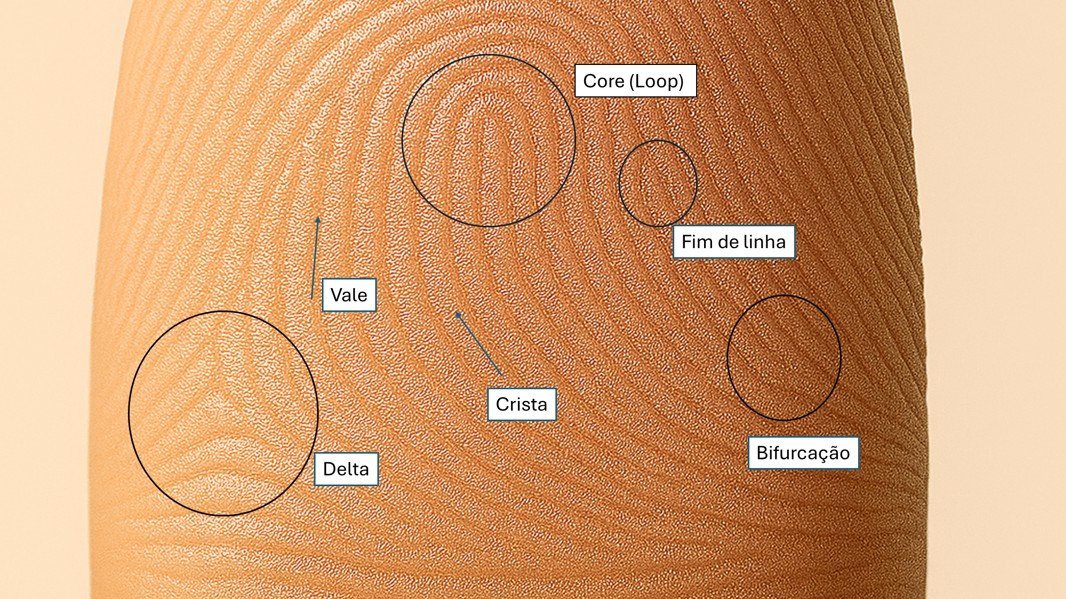
- Fingerprint: minutiae (bifurcations, ridge endings)
- Palm print: textures, patterns, characteristic points
These features are grouped into information sets called templates, which must be:
- Stable
- Reproducible
- Compact
- Resistant to natural variations (e.g., aging)
4. Matching Mechanism
The system compares the newly generated template with:
- A stored template (1:1)
- An entire database (1:N)
Here we encounter:
- False positive — an impostor is incorrectly accepted
- False negative — a legitimate user is not recognized
5. Liveness Detection (Proof of Life)
Without liveness, any biometric system is vulnerable.
For each modality:
- Face: deepfake detection, photos, videos
- Fingerprint: artificial fingers, silicone, gel
- Palm print: prosthetics, artificial surfaces
Liveness can be active or passive.
How does FIDO2 integrate with biometric systems?
The FIDO2 standard adds a cryptographic layer that complements biometrics:
- The private key stays on the device
- The server never stores biometric data
- Authentication is resistant to phishing
- Works with local biometrics (face, fingerprint, palm print)
For cybersecurity, the combination biometrics + FIDO2 is currently one of the strongest available.
What requirements must a biometric system meet according to Anil Jain?
Researcher Anil Jain, one of the world’s leading authorities in biometrics, defines essential requirements:
- Universality — everyone must possess the characteristic
- Uniqueness — each person must be distinguishable
- Permanence — stability over time
- Collectability — ability to capture with quality
- Performance — speed and accuracy
- Acceptability — user comfort
- Security — resistance to attacks
These requirements apply to face, fingerprint, and palm print.
What performance metrics are used to evaluate biometric systems?
The most important metrics are:
- FAR (False Acceptance Rate) — false positive
- FRR (False Rejection Rate) — false negative
- EER (Equal Error Rate)
- ROC Curve
- Response time
- Liveness success rate
Each modality behaves differently:
- Fingerprints tend to have very low FAR
- Palm print is more resistant to forgery
- Facial biometrics depend more on capture quality
Why does facial recognition fail in some cases?
Reasons include:
- Poor lighting
- Weak camera
- Poorly trained algorithm
- Lack of normalization
- Absence of liveness
- Incorrect parameter tuning
- Ethnic bias (poor performance for certain etnical groups)
In many cases, the solution is to complement facial biometrics with fingerprint or palm print.
How does biometric customer onboarding work?
The typical flow includes:
- Capture (face, fingerprint, or palm print)
- Liveness detection
- Document reading
- Biometric vs. document comparison
- Template creation
- Secure storage
- Future verification
To be efficient, onboarding must be:
- Fast
- Intuitive
- Fraud‑resistant
- Compatible with various mobile devices
What should cybersecurity teams consider when selecting a biometric system?
1. Robustness against attacks
Each modality has specific threats:
- Face: deepfakes, photos, videos
- Fingerprint: molds, silicone
- Palm print: prosthetics, artificial surfaces
2. Quality of liveness detection
Must be auditable and certified.
3. Transparency of metrics
Vendors must present FAR, FRR, EER, and attack detection rates.
4. Secure storage
Templates must be:
- Encrypted
- Non‑reversible
- Protected against leaks
5. Device compatibility
Especially for fingerprint and palm print sensors.
6. User experience
Cybersecurity cannot ignore UX.
Conclusion: What do you really need in a biometric system?
You need a solution that:
- Has intelligent capture
- Supports face, fingerprint, and palm print
- Uses modern feature extraction
- Has certified liveness
- Provides transparent metrics
- Is secure against attacks
- Works well on common smartphones
- Meets Anil Jain’s requirements
- Has low false‑positive and false‑negative rates
- Preferably integrates biometrics with FIDO2
Biometric systems combine engineering, security, user experience, and data science. Choosing well means protecting your customers’ digital identity and ensuring reliable onboarding and proof‑of‑life processes.
Suggestion: read about Multimodal Biometrics.