
Blog
Recoverable Revenue: The Hidden Growth Indicator in Your E-commerce

Recoverable Revenue: The Hidden Growth Indicator in Your E-commerce
Fraud is visible.
Chargebacks show up in reports.
Product loss hits the cash flow.
But one indicator rarely reaches the CEO or CFO’s desk—and it may be limiting operational growth: Recoverable Revenue.
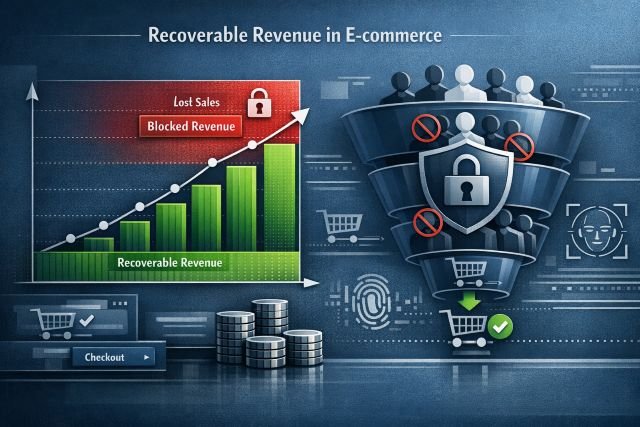
Recoverable Revenue represents the volume of legitimate sales blocked by excessive controls, false positives, or friction in authentication processes.
It’s money that could have entered the business—without increasing real risk—but got lost along the way.
Excessive Focus on Fraud Can Distort Strategy
In recent years, digital retail has heavily invested in fraud prevention. Stricter tools, additional validation layers, and conservative processes became standard.
The result? Fraud is more controlled.
But often at the cost of conversion.
When a legitimate customer is wrongly blocked:
- The sale is lost.
- The customer acquisition cost (CAC) is wasted.
- Future repurchases vanish.
- The customer may switch to a competitor.
This phenomenon has a name: Legitimate Revenue Blockage.
In mature operations, its financial impact can exceed the losses caused by actual fraud.
The Effect of BIometric Friction on Revenue
Biometric authentication and liveness checks have improved security in onboarding and checkout. Yet, when poorly calibrated, they also create friction.
Data shows that:
- 38% of users abandon after two failed biometric attempts.
- 52% abandon after three attempts.
Each failure represents a potential leak of Recoverable Revenue.
For the CFO, this isn’t just an operational issue.
It’s a matter of investment efficiency and maximizing the active customer base.
Security and Growth Don’t Have to Be Opposites
The classic e-commerce dilemma:
- Loosen controls, and fraud rises.
- Tighten them too much, and conversion drops.
But this doesn’t have to be a binary choice.
Applying Biometric Balance allows companies to block identity fraud during onboarding without increasing Legitimate Revenue Blockage.
In practice, this means:
- Keeping risk under control.
- Reducing false positives.
- Minimizing unnecessary friction.
- Unlocking Recoverable Revenue.
The Strategic Question
Most operations closely monitor fraud rates.
Few systematically track how much legitimate revenue is being blocked.
The question CEOs and CFOs should be asking is simple:
How much of our revenue is being lost—not to fraud, but to the fear of it?