
Blog
What Are Deepfakes and How Do They Affect Your Biometrics?

What Are Deepfakes and How Do They Affect Your Biometrics?
When you posted that innocent photo on social media and didn’t think much of it, you probably didn’t imagine the consequences. It’s important to understand the risks behind a type of fraud that uses exactly this kind of information: deepfakes, or AI‑generated identity manipulation.
How Do Deepfakes Affect My Facial Biometrics?
Deepfakes affect facial biometrics because they manipulate images and videos with enough precision to fool recognition systems. Facial biometrics rely on visual patterns, and these patterns can be artificially replicated by AI models trained to imitate expressions, movements, and detailed features of the human face. When this happens, facial biometrics fail, since the system cannot distinguish a real face from a synthetic one. This type of fraud opens the door to account breaches, identity theft, and increasingly sophisticated digital scams.
Where Do Deepfakes Come From?
Deepfakes originate from artificial intelligence models trained with large volumes of photos and videos available online. Social networks, image banks, and video platforms have become abundant sources for anyone looking to create realistic manipulations. As these tools become more popular, anyone with access to advanced editing software can generate fake videos with impressive quality. The combination of public data and accessible technology explains the rapid growth of this type of content.
Where Can I Find Consulting Services for Deepfake Security?
Cybersecurity consulting firms already offer services focused on protection against deepfakes. These companies analyze biometric systems, implement highly reliable biometric authentication, monitor AI‑related threats, and train teams to identify digital manipulation. Identity‑verification startups and companies specializing in biometrics also operate in this field, providing corporate solutions for banks, fintechs, e‑commerce platforms, and any service that depends on secure authentication.
What Are the Main Risks of Posting Personal Photos on Social Media?
Posting personal photos on social media significantly increases your exposure. The more photos you publish, the larger the dataset available for anyone trying to create convincing deepfakes. This makes it easier to create fake profiles, manipulate videos for defamation, attempt fraud involving facial biometrics, and misuse your identity in scams. High‑resolution images make the process even simpler for digital criminals.
How Can I Protect My Online Image From Misuse by AI?
Protecting your online image requires constant attention. An effective strategy is to avoid posting high‑resolution photos, since they provide more detail for AI models. It’s also important to limit the visibility of your posts, use subtle watermarks on public images, and review permissions granted to apps that access your camera or gallery. Additionally, enabling security alerts on social networks helps you quickly identify any misuse of your image. For banking services and sensitive platforms, choose highly reliable biometric authentication methods, such as digital biometrics.
How Can I Protect My Image From Malicious Deepfakes?
Protection against malicious deepfakes involves actively monitoring your online presence. Regularly searching for your name and image on search engines helps identify fake content before it spreads. Deepfake‑detection tools can also assist in verifying suspicious videos. If you find manipulated content, request immediate removal from the responsible platforms. Companies specializing in biometric identity verification offer solutions capable of detecting manipulation in videos and photos, strengthening the security of your digital identity.
Companies Specializing in Biometric Identity Verification
The biometric market has grown rapidly due to the increase in digital fraud. Specialized companies offer facial verification with liveness detection, digital biometrics using fingerprints captured by mobile devices, and hybrid systems that combine multiple authentication methods. These solutions are widely used by banks, fintechs, logistics companies, and e‑commerce platforms. Combining different biometric methods increases security and reduces the likelihood of forgery.
What Is the Difference Between Deepfakes and Traditional Visual Effects?
The difference between deepfakes and traditional visual effects lies in the creation process. Visual effects depend on manual editing, specialized professionals, and long hours of work. Deepfakes, on the other hand, use artificial intelligence to automate manipulation, allowing fake videos to be produced quickly and with a high level of realism. This ease makes deepfakes more dangerous, especially when used to bypass facial biometric systems or create malicious content.
What Biometric Options Exist to Combat Deepfakes?
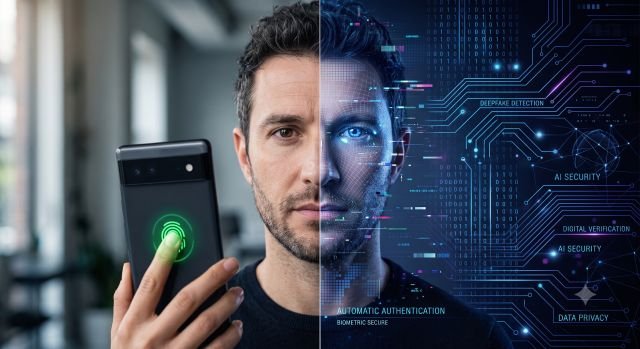
To combat deepfakes, companies adopt more robust biometric methods. Digital biometrics, based on fingerprints, are extremely difficult to forge because they require physical contact and sensors capable of detecting skin texture, depth, and temperature. Mobile fingerprint biometrics have become a highly reliable alternative, especially in modern devices. Additionally, voice recognition with tone analysis and video‑based liveness detection help identify patterns that AI cannot replicate. Combining different biometric methods increases security and reduces vulnerability to fraud.
Learn more about our mobile fingerprint biometric technology for smartphones on our website.
How Can I Protect My Online Image From Misuse by AI?
Protecting your online image requires discipline and constant review of your digital habits. Avoid sending selfies to unknown services, disable facial recognition on platforms that do not require high security, and review app permissions regularly. The fewer data you provide, the lower the risk of misuse. In environments that require strong protection, digital biometrics remain the most reliable option.
Is Digital Biometrics (Fingerprints) Deepfake‑Proof?
Digital biometrics are currently one of the most secure authentication methods. Fingerprints are unique and extremely difficult to replicate artificially. Unlike facial biometrics, which can fail when confronted with deepfakes, digital biometrics require physical contact and advanced sensors that detect real skin characteristics. For this reason, mobile fingerprint biometrics have become a highly reliable solution for protecting accounts and devices. Although no system is completely infallible, digital biometrics are far more resistant to AI‑driven fraud than facial biometrics.
Read another article: Biometric Alternatives for Mobile Authentication.